
Laboratory for Proteome Analyses and Protein Characterization, Professor Jan J. Enghild
The group is interested in plasma-proteins and the extracellular matrix (ECM) and its crosstalk with normal and pathological processes, in particular the regulation of proteolytic activity and the influence of post-translational modifications on protein function.
The extracellular matrix (ECM) is where all cells live; they do not just function as a mechanical support for the cells, but are dynamic structure that provide signals to regulate cell adhesion, cell-to-cell communication, differentiation and inflammation. An example from the lab of this inter-play involves the bikunin proteins. These are found in the blood although they mainly play a role in the ECM. The proteins have a unique structure where the subunits are covalently cross-linked by a glycosaminoglycan chain. This cross-link is able to participate in a transesterfication reaction where the heavy chains of the bikunin proteins are transferred to other glycosaminoglycan molecules in the ECM. This process participates in the mechanical stabilization of the ECM with impact on cell adhesion and migration. The other major research area in the laboratory is plasma-proteins. Here we mainly focus on the characterization of coagulation- and fibrinolysis-related proteins. We use a combination of protein chemistry, proteomics, targeted mass spectrometry, enzymology, and recombinant DNA techniques to address scientific problems of interest.
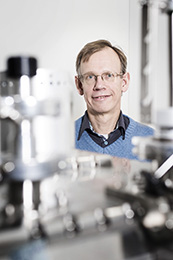
Soft Matter Group, Jan Skov Pedersen, PhD and Dr. Scient, Professor
The central topic in our research is to determine how molecules interact and self-assemble into higher order structures and provide an understanding of the mechanisms that lie behind this. The knowledge is used for directing self-assembly in many types of systems and designing systems with controlled response that can be used, for example, in drug delivery systems.
Self-assembly of molecules in solution is fundamental process in living systems as well as in many commercial products. Many types of interactions (hydrophobic, electrostatic, hydrogen bonding …) can lead to self-assembly and the control and understanding of these interactions are crucial for formation of stable particles and structures. Among the systems we investigate are block coacervate copolymer micelles, lipid-protein complexes, and microemulsions. These are all systems that have applications in controlled drug delivery and which may be designed to have responsive behavior, so that release can be triggered by, e.g., temperature, ionic strength or pH changes. The experimental investigations are mainly done on the in-house SAXS equipment, and they are supplemented by a suite of other techniques.
A new powerful SAXS equipment will be installed ultimo 2014. It will have specially designed optics and use a high intensity liquid metal jet X-ray source, and will allows time-resolved measurements with a time resolution of a second.
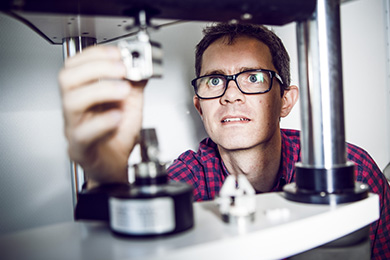
Mechanical and Materials Engineering Section at the Department of Engineering Jens Vinge Nygaard, PhD in Mechanical Engineering, Associate Professor.
Mechanical Engineering is about studying the fundamental mechanisms behind any movement and the energy converted in the process of moving. Materials Engineering is about applying the properties of matter to engineer devices exploiting internal structures within the materials, and thereby dictate how the material moves or redistribute energy internally once in service.
Engineering is also about making new technologies and access to advanced materials has often driven technological breakthroughs. The usage of composite materials enables us to engineer enhanced performance, or build additional function into the material. Access to well characterised polymers, improved control, and enhanced automation in materials processing, have lead to the development of materials printing – 3D printers. Coupled with nanotechnology new ways emerge to build and assemble advanced material structures into 3D composites at shorter length scales. Mechanical Engineers use Computer Aided Design tools to synthesize the geometry of any product and mathematically investigate its performance, and the tools are applicable to nanofabrication. Thus, Materials Engineering is becoming a digital development cycle.
Our current projects focus on the synthesis of bioactive medical devices manufactured by additive techniques such as fused deposition modelling and electro spinning. They are for Tissue Engineering of connective tissue in the pelvic floor region and cartilage in the joints of the skeletal system. The projects are in collaboration with Aarhus University Hospital and Biotech Companies.

Nanocatalysis group, Jeppe Vang Lauritsen, Associate professor, iNANO
Our research provides atomic-level insight into the working principles of catalytic nanomaterials. The aim is to rationally design catalysts on this fundamental knowledge base for use in better environmental protection technologies and renewable energy production.
We investigate how we can control nanoscale properties such as nanoparticle size, shape and surface structure to improve catalytic activity. We carry out this research by imaging their surfaces under the influence of reactants directly at the atomic scale by using a range of scanning tunneling microscopes (STM) and atomic force microscopes (AFM). A current research goal is to develop improved catalysts for the reduction of smog problems caused by NOx and SOx emissions. A key to catalyst development is also to understand how support materials can be chemically modified or nanostructured to better anchor the nanoparticles in a bottom-up process. This research theme is pursued for the Cu/ZnO catalyst used for methanol synthesis (a possible biofuel) and various metal catalysts on the most common support in industrial catalysts, Al2O3.
Although our research on catalysis is fundamental in character, it is of distinct importance to the catalysis industries and we collaborate with several companies and research institutes. Catalysis is a truly interdisciplinary research area and we continuously look for new opportunities for collaborations.
