
Specialized iNANO lecture by Brian Seger, Technical University of Denmark (DTU), Denmark
A synchrotron analysis of high current density CO2 electrolysis devices
Info about event
Time
Location
AUD VI (1510-213), Dept. of Chemistry
Organizer
Brian Seger, Technical University of Denmark (DTU), Denmark
A synchrotron analysis of high current density CO2 electrolysis devices
This talk will analyze CO2 electrolysis from a device perspective to provide insight into what are the bottlenecks in the field and how to resolve them. We will focus on our synchrotron based results using small angle and wide angle x-ray scattering as well as x-ray fluorescence to observe CO2 electrolysis devices in real time while concomitantly measuring anode and cathode product distributions.
During higher current density (>100 mA/cm2) CO2 electrolysis devices are prone to cathodic ‘flooding’ leading to greatly enhanced hydrogen production, which can occur via a chaotic oscillatory nature. Via our various in-situ analysis tools, we can explain the basis for this flooding, which is primarily due to salt deposition.1 By analyzing various salts (Li+, Na+, K+, Cs+) of differing solubility we show this trend more clearly.2 As Cs cations fluoresce,3 this allows us to show how an applied potential drags these cation salts through an anion exchange membrane, leading to the salt build-up and concomitant deposition in these electrolyzers.
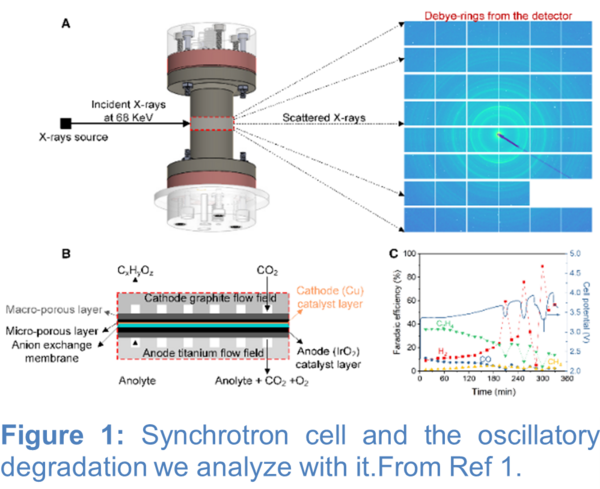
As CO electrolysis allows us to switch to more soluble hydroxide salts, we show this is a major key to ensuring long-term stability (>100 hours).4 However practical issues such as anodic dissolution of IrO2 can redeposit on the cathode producing hydrogen as shown by our synchrotron results. Switching to a nickel anode resolve this, however we show that the anodic pH must be controlled to prevent acetate/acetic acid from driving the pH down, and thus corroding the device.
References:
1 Moss, AB, Garg, S, et al. Joule 2023, 7,2, 350-365
2 Garg, S. Xu, Q, et al. Energy & Environmental Science, 2023 16, 1631-1643
3 Xu, Q, Garg, S, et al. Nat. Cat. 2023, 11, 1042-1051
4 Joensen, B, Xu, Q. et al. Joule 2024, 8, 6, 1754-177