Aarhus University Seal

Exosomes

Exosomes are small membrane vesicles of endocytic origin secreted by most cell types in vitro. Cells continuously secrete a large number of microvesicles, exosomes and small molecules into the extracellular space. Exosomes have been shown to contain mRNA and miRNA and they are able to mediate communication between cells, by transport of RNA and proteins which can be functionalized in the recipient cell. The ability to transport bioactive cargoes, gives exosomes innate therapeutic potential as a natural drug carrier. Efficient techniques for loading drugs into exosomes to utilize the natural carrier capabilities of these vesicles remains to be elucidated.
Applications of Exosomes

The presence exosomes in blood, saliva, and urine paves the way for the possible application of exosomes as a diagnostic marker for diseases. Many diseases are difficult to detect by the methods and equipment available today and there is a growing demand for development of new non‐invasive methods to detect diseases in early stages. The use of exosomes as markers of disease is being investigated to cement their potential as a non-invasive diagnostic tool for early detection of many diseases, in particular cancers. This, however, relies on thorough characterisation of exosomes in both healthy and diseased states

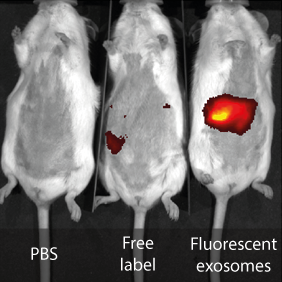
An important factor to understanding the roles of exosomes is knowledge of their biodistribution. Currently, the number of publications describing the biodistribution of exosomes is limited. The main reason being the lack of a robust fluorescent label that can be visualised in vivo. Mapping the specific cell type derived exosomes can increase our knowledge on the roles of exosomes in the organism, as well as help to identify natural targeting systems.

Isolation, Characterisation and Fluorescent Labelling

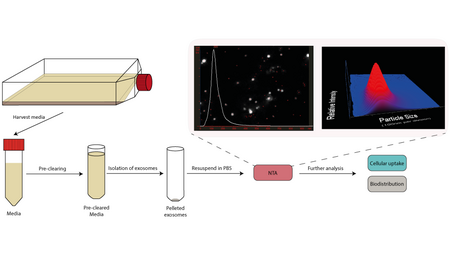
The most common isolation protocol uses a differential centrifugation to fractionate cells, microvesicles, and exosomes, which are pelleted by ultracentrifugation. After vesicles are secreted from cells into the extracellular environment, it difficult to separate the different subpopulations of vesicles to obtain a pure sample. We have developed methods to optimise isolation and thorough characterisation procedures to obtain pure and well-characterised exosomes. Furthermore, we have developed a simple method for labelling of exosomes with a robust fluorescent label that can be visualised in vivo, allowing investigation of the biodistribution of different cell derived exosomes.
Collaborators:

Department of Clinical Medicine, Aarhus University Hospital, Denmark

Dan Peer, Department of Cell Research & Immunology, Tel Aviv University, Israel

Moein Moghimi, school of Medicine, Pharmacy and Health, Durham University, UK

Recent Publications

Sort by: Date | Author | Title

Gerhardy, P, Baaz, M (ed.) & Makowsky, JA (ed.) 2003, Refined Complexity Analysis of Cut Elimination. in Ikke angivet. 2803 of Lecture Notes in Computer Science edn, Springer, pp. 212-225, CSL 2003, Wien, Austria, 25/08/2003.
Gerhardy, P & Kohlenbach, U 2003, 'Extracting Herbrand Disjunctions by Functional Interpretation', BRICS Report Series, no. RS-03-32.
Gerhardy, P & Kohlenbach, U 2004, 'Strongly Uniform Bounds from Semi-Constructive Proofs', BRICS Report Series, no. RS-04-31.
Gerhardy, P 2005, 'Extracting Herbrand Disjunctions by Functional Interpretation', Archive for Mathematical Logic, vol. 44, pp. 633-644.
Gerhardy, P 2005, 'The Role of Quantifier Alternations in Cut Elimination', Notre Dame Journal of Formal Logic, vol. 46, no. 2, pp. 165-171.
Gerhardy, P 2006, 'A Quantitative Version of Kirk's Fixed Point Theorem for Asymptotic Contractions', Journal of Mathematical Analysis and Applications, vol. 316, no. 1, pp. 339-345.
Gerhardy, P & Kohlenbach, U 2006, 'Strongly uniform bounds from semi-constructive proofs', Annals of Pure and Applied Logic, vol. 141, pp. 89-107.
Gerhardy, P 2006, Functional interpretation and modified realizability interpretation of the double-negation shift. in A Beckmann, U Berger, B Löwe & JV Tucker (eds), Logical Approaches to Computational Barriers: CiE 2006. vol. CSR 7-2006 in Computer Science Report Series, University of Wales Swansea, Computability in Europe 2006, Swansea, United Kingdom, 30/06/2006.
Gerhardt, R & Meyer, S 2013, 'The effect of personal portfolio reporting on private investors', Financial Markets and Portfolio Management, vol. 27, no. 3, pp. 257-273. https://doi.org/10.1007/s11408-013-0214-9
Gerhards, F & Christensen, S 2006, Site-Specific Weed Management. in A Scrinivasan (ed.), Handbook of Precision Agriculture. <Forlag uden navn>, pp. 185-199.
Gerhards, L & Siemer, N 2014 'Private versus Public Feedback - The Incentive Effects of Symbolic Awards' Institut for Økonomi, Aarhus Universitet, Aarhus.
Gerhards, L & Gravert, CA 2015 'Grit Trumps Talent? An experimental approach' Economics Working Papers, no. 2015-18, Institut for Økonomi, Aarhus Universitet, Aarhus.
Gerhard, A, Trender-Gerhard, I, Turkheimer, F, Quinn, NP, Bhatia, KP & Brooks, DJ 2006, 'In vivo imaging of microglial activation with [11C]-PK11195 PET progresive supranuclear palsy', Movement Disorders, vol. 21, no. 1, pp. 89-93. https://doi.org/10.1002/mds.20668
Gerhard, A, Pavese, N, Hotton, G, Turkheimer, F, Es, M, Hammers, A, Eggert, K, Oertel, W, Banati, RB & Brooks, DJ 2006, 'In vivo imaging of microglial activation with [11C](R)-PK11195 PET in idiopathic Parkinson's disease', Neurobiology of Disease, vol. 21, no. 2, pp. 404-412. https://doi.org/10.1016/j.nbd.2005.08.002
Gerhard, A, Watts, J, Trender-Gerhard, I, Turkheimer, F, Banati, RB, Bhatia, K & Brooks, DJ 2004, 'In vivo imaging of microglial activation with [11C](R -PK11195 PET in corticobasal degeneration', Movement Disorders, vol. 19, no. 10, pp. 1221-1226. https://doi.org/10.1002/mds.20162
Gerhard, A, Banati, RB, Goerres, GB, Cagnin, A, Myers, R, Gunn, RN, Turkheimer, F, Good, CD, Mathias, CJ, Quinn, N, Schwarz, J & Brooks, DJ 2003, '[11C](R)-PK11195 PET imaging of microglial activation in multiple system atrophy', Neurology, vol. 61, no. 5, pp. 686-689. https://doi.org/10.1212/01.WNL.0000078192.95645.E6
Gerhard, AP, Krücken, J, Heitlinger, E, Janssen, IJI, Basiaga, M, Kornaś, S, Beier, C, Nielsen, MK, Davis, RE, Wang, J & von Samson-Himmelstjerna, G 2020, 'The P-glycoprotein repertoire of the equine parasitic nematode Parascaris univalens', Scientific Reports, vol. 10, no. 1, 13586. https://doi.org/10.1038/s41598-020-70529-6
Gerhard, M, Dias, JD, Carvalho, I, Striebel, M & Meerhoff, M 2025, 'Phytoplankton thermal response curves in natural communities of different origins', Journal of Plankton Research, vol. 47, no. 5, fbaf046. https://doi.org/10.1093/plankt/fbaf046
Gergely, G & Lövei, G 1987, 'Phenology and reproduction of the ground beetle, Dolichus halensis in maize fields: a preliminary report', Acta Phytopathologica et Entomologica Hungarica, vol. 22, pp. 355-359.
Gerecht, A, Carotenuto, Y, Ianora, A, Romano, G, Fontana, A, d'Ippolito, G, Jakobsen, HH & Nejstgaard, JC 2013, 'Oxylipin production during a mesocosm bloom of Skeletonema marinoi', Journal of Experimental Marine Biology and Ecology, vol. 446, pp. 159-165. https://doi.org/10.1016/j.jembe.2013.05.014
Gerdes, U 2003, 'Prøvetagning som kilde til præanalytisk variation', Klinisk Biokemi i Norden, vol. 15, no. 4, pp. 14-16.
Gerdes, U 2003, 'The common polymorphism of apolipo-protein E: Geographical aspects and new patho-physiological relations', Clinical Chemistry and Laboratory Medicine, vol. 5, no. 41, pp. 628-631.
Gerdes, U, Brønnum-Hansen, H, Osler, M, Madsen, M, Jørgensen, T & Schroll, M 2002, 'Trends in life style coronary risk factors in the Danish MONICA population 1982-1992', Dazhong Jiankang, no. 116, pp. 81-88.
Gerdes, LU 2005, 'Metodesammenligning', Klinisk Biokemi i Norden, vol. 17, no. 3, pp. 24-28.
Gerdes, LU & Hilsted, L 2005, 'Akkreditering og kvalitet', Klinisk Biokemi i Norden, vol. 17, no. 1, pp. 28-34.
Gerdes, C & Hansen, PS 2006, 'Electrocardiography. Tips & tricks.', Ugeskrift for Læger, vol. 168, no. 3, pp. 274-6.
Gerdes, IM & Geertz, AW 2007, Religiøs omvendelse: Socialpsykologiske og neurovidenskabelige perspektiver. in MS Mogensen & JHM Damsager (eds), Dansk konversionsforskning. Forlaget Univers, Århus, pp. 43-71.
Gerdes, LU, Lindholt, JS, Vammen, S, Henneberg, EW & Fasting, H 2000, 'Apolipoprotein E genotype is associated with differential expansion rates of small abdominal aortic aneurysms', British Journal of Surgery, vol. 87, no. 6, pp. 760-5. https://doi.org/10.1046/j.1365-2168.2000.01486.x
Gerdes, C, Gränsmark, P & Rosholm, M 2011 'Chicken or Checkin'? Rational Learning in Repeated Chess Games' IZA Discussion Paper, no. 5862, Institute for the Study of Labor (IZA), Bonn. <http://www.iza.org/en/webcontent/publications/papers/viewAbstract?dp_id=5862>
Gerdes, C, Baslund, B, Feldt-Rasmussen, U, Kastrup, J & Sørensen, PS 2012, Arytmi. in Medicin. FADL's Forlag, København.
Gerdes, A-M & Vogel, I 2014, 'Klinisk genetik og genomet', Ugeskrift for Læger, vol. 176, no. 46.
Gerdes, N 2024, Epicurean virtues for a post-heroic age? Tracing the critique of heroism in Antoinette Deshoulières' poetry and drama. in C Franzén & J Vernqvist (eds), Body, Gender, Senses: Subversive Expressions in Early Modern Art and Literature. De Gruyter, pp. 77-98. https://doi.org/10.1515/9783110799330-005
Gercheva, RS, Chitti, SH, Prasad, NR & Prasad, R 2013, 'Review on the benefits of converged next generation network architecture', International Symposium on Wireless Personal Multimedia Communications, WPMC.
Gerber, AS, Huber, GA, Meredith, M, Biggers, DR & Hendry, D 2015, 'Can Incarcerated Felons Be (Re)integrated into the Political System? Results from a Field Experiment', American Journal of Political Science, vol. 59, no. 4, pp. 912-926. https://doi.org/10.1111/ajps.12166