Aarhus University Seal

Exosomes

Exosomes are small membrane vesicles of endocytic origin secreted by most cell types in vitro. Cells continuously secrete a large number of microvesicles, exosomes and small molecules into the extracellular space. Exosomes have been shown to contain mRNA and miRNA and they are able to mediate communication between cells, by transport of RNA and proteins which can be functionalized in the recipient cell. The ability to transport bioactive cargoes, gives exosomes innate therapeutic potential as a natural drug carrier. Efficient techniques for loading drugs into exosomes to utilize the natural carrier capabilities of these vesicles remains to be elucidated.
Applications of Exosomes

The presence exosomes in blood, saliva, and urine paves the way for the possible application of exosomes as a diagnostic marker for diseases. Many diseases are difficult to detect by the methods and equipment available today and there is a growing demand for development of new non‐invasive methods to detect diseases in early stages. The use of exosomes as markers of disease is being investigated to cement their potential as a non-invasive diagnostic tool for early detection of many diseases, in particular cancers. This, however, relies on thorough characterisation of exosomes in both healthy and diseased states

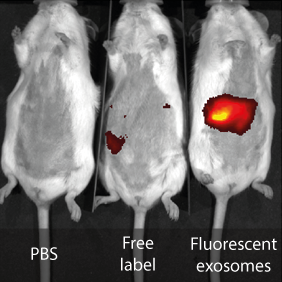
An important factor to understanding the roles of exosomes is knowledge of their biodistribution. Currently, the number of publications describing the biodistribution of exosomes is limited. The main reason being the lack of a robust fluorescent label that can be visualised in vivo. Mapping the specific cell type derived exosomes can increase our knowledge on the roles of exosomes in the organism, as well as help to identify natural targeting systems.

Isolation, Characterisation and Fluorescent Labelling

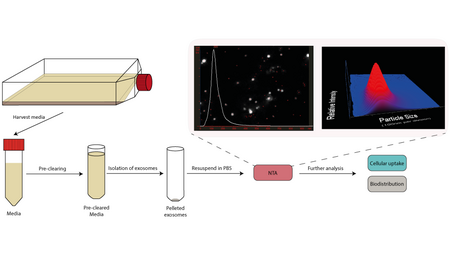
The most common isolation protocol uses a differential centrifugation to fractionate cells, microvesicles, and exosomes, which are pelleted by ultracentrifugation. After vesicles are secreted from cells into the extracellular environment, it difficult to separate the different subpopulations of vesicles to obtain a pure sample. We have developed methods to optimise isolation and thorough characterisation procedures to obtain pure and well-characterised exosomes. Furthermore, we have developed a simple method for labelling of exosomes with a robust fluorescent label that can be visualised in vivo, allowing investigation of the biodistribution of different cell derived exosomes.
Collaborators:

Department of Clinical Medicine, Aarhus University Hospital, Denmark

Dan Peer, Department of Cell Research & Immunology, Tel Aviv University, Israel

Moein Moghimi, school of Medicine, Pharmacy and Health, Durham University, UK

Recent Publications

Sort by: Date | Author | Title

Bougouin, A, Appuhamy, JADRN, Ferlay, A, Kebreab, E, Martin, C, Moate, PJ, Benchaar, C, Lund, P & Eugène, M 2019, 'Individual milk fatty acids are potential predictors of enteric methane emissions from dairy cows fed a wide range of diets: Approach by meta-analysis', Journal of Dairy Science, vol. 102, no. 11, pp. 10616-10631. https://doi.org/10.3168/jds.2018-15940
Larsen, L 2019, 'Individual psychotherapy improves the well-being of elderly Danish care-recipients', 33rd Congress of the European Federation of Psychology Students' Association (EFPSA), Grenaa, Denmark, 07/04/2019 - 14/04/2019.
Langhave, I 2019, Indkomst ved erhvervsmæssig virksomhed. in A Michelsen, J Bolander, L Madsen, AN Laursen & I Langhave (eds), Lærebog om indkomstskat. 18 edn, Djøf Forlag, Kbh., pp. 209-268.
Hansen, JH & Petersen, KE 2019, Indledning. in KE Petersen & JH Hansen (eds), Inklusion og eksklusion : en grundbog. Hans Reitzels Forlag, København, pp. 17-26.
Gram-Skjoldager, K, Bille, M & Engberg-Pedersen, A 2019, Indledning. in M Bille, A Engberg-Pedersen & K Gram-Skjoldager (eds), Verden ifølge humaniora: 40 banebrydende begreber der former vores virkelighed. Aarhus Universitetsforlag, Aarhus, pp. 11-20.
Hansen, JW & Göke, C 2019, Indledning. in JW Hansen (ed.), Marine områder 2017. NOVANA. Aarhus University, DCE - Danish Centre for Environment and Energy, Videnskabelig rapport fra DCE - Nationalt Center for Miljø og Energi, no. 308, pp. 11-15. <http://dce2.au.dk/pub/SR308.pdf>
Høiris, O & Marquardt, O 2019, Indledning. in O Høiris, O Marquardt & GA Reimer (eds), Grønlændernes syn på Danmark: historiske, kulturelle og sproglige perspektiver. Aarhus Universitetsforlag, Aarhus, pp. 7-20.
Laursen, AN 2019, Indledning. in A Michelsen, J Bolander, L Madsen, AN Laursen & I Langhave (eds), Lærebog om indkomstskat. 18 edn, Djøf Forlag, pp. 49-58.
Kousholt, K, Krejsler, JB & Nissen, M 2019, Indledning. in K Kristine, JB Krejsler & M Nissen (eds), At skulle ville: Om motivationsarbejde og motivationens tilblivelse og effekter. Samfundslitteratur, Frederiksberg, pp. 11-20.
Andersen, LK, Hobel, P & Holgersen, S-E 2019, Indledning. in L Krogager Andersen, P Hobel & S-E Holgersen (eds), Tværfaglighed og fagligt samspil. Aarhus Universitetsforlag, Aarhus, Didaktiske studier, vol. 6, pp. 7-16.
Hansen, JW, Larsen, MM & Göke, C 2019, Indledning. in JW Hansen & S Høgslund (eds), Marine områder 2018: NOVANA. Aarhus Universitet, Aarhus, Videnskabelig rapport fra DCE - Nationalt Center for Miljø og Energi, no. 355, pp. 8-13. <https://dce2.au.dk/pub/SR355.pdf>
Glasdam, S & Boelsbjerg, HB 2019, Indledning. in Folkesundhed – bag om intentioner og strategier. . Gad.
Primdahl, SC, Juul, I & Hansen, AM 2019, 'Indledning: Udviklingslinjer og forandringer i den aktive arbejdsmarkedspolitik', Tidsskrift for Arbejdsliv, vol. 21, no. 1, pp. 5-9.
Hansen, AS & Højlund, S 2019, Indledning: Antropologiske perspektiver på deling. in AS Hansen, S Højlund, CMS Pallesen & M Rytter (eds), Hvad vi deler : Antropologiske perspektiver på deling som socialt fænomen. Aarhus Universitetsforlag, Aarhus, Antropologiske Studier, no. 5, pp. 7-18.
Nørgaard, I 2019, Indledning om skifte. in I Nørgaard, C Adolphsen & EN Jensen (eds), Familieret. 4. edn, Djøf Forlag, Kbh., pp. 247-254.