Aarhus University Seal

Exosomes

Exosomes are small membrane vesicles of endocytic origin secreted by most cell types in vitro. Cells continuously secrete a large number of microvesicles, exosomes and small molecules into the extracellular space. Exosomes have been shown to contain mRNA and miRNA and they are able to mediate communication between cells, by transport of RNA and proteins which can be functionalized in the recipient cell. The ability to transport bioactive cargoes, gives exosomes innate therapeutic potential as a natural drug carrier. Efficient techniques for loading drugs into exosomes to utilize the natural carrier capabilities of these vesicles remains to be elucidated.
Applications of Exosomes

The presence exosomes in blood, saliva, and urine paves the way for the possible application of exosomes as a diagnostic marker for diseases. Many diseases are difficult to detect by the methods and equipment available today and there is a growing demand for development of new non‐invasive methods to detect diseases in early stages. The use of exosomes as markers of disease is being investigated to cement their potential as a non-invasive diagnostic tool for early detection of many diseases, in particular cancers. This, however, relies on thorough characterisation of exosomes in both healthy and diseased states

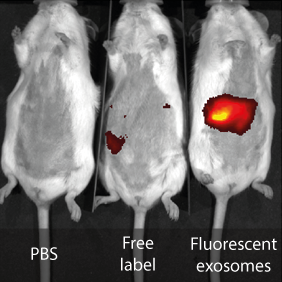
An important factor to understanding the roles of exosomes is knowledge of their biodistribution. Currently, the number of publications describing the biodistribution of exosomes is limited. The main reason being the lack of a robust fluorescent label that can be visualised in vivo. Mapping the specific cell type derived exosomes can increase our knowledge on the roles of exosomes in the organism, as well as help to identify natural targeting systems.

Isolation, Characterisation and Fluorescent Labelling

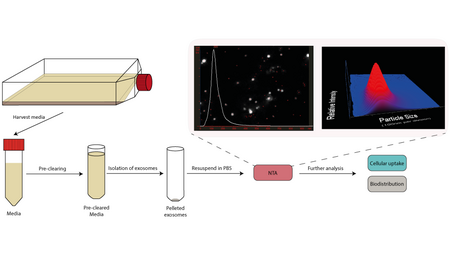
The most common isolation protocol uses a differential centrifugation to fractionate cells, microvesicles, and exosomes, which are pelleted by ultracentrifugation. After vesicles are secreted from cells into the extracellular environment, it difficult to separate the different subpopulations of vesicles to obtain a pure sample. We have developed methods to optimise isolation and thorough characterisation procedures to obtain pure and well-characterised exosomes. Furthermore, we have developed a simple method for labelling of exosomes with a robust fluorescent label that can be visualised in vivo, allowing investigation of the biodistribution of different cell derived exosomes.
Collaborators:

Department of Clinical Medicine, Aarhus University Hospital, Denmark

Dan Peer, Department of Cell Research & Immunology, Tel Aviv University, Israel

Moein Moghimi, school of Medicine, Pharmacy and Health, Durham University, UK

Recent Publications

Sort by: Date | Author | Title

Palmfeldt, J, Rådström, P & Hahn-Hägerdal, B 2003, 'Optimisation of initial cell concentration enhances freeze-drying tolerance of Pseudomonas chlororaphis.', Cryobiology, vol. 47, no. 1, pp. 21-9.
Børgesen, CD & Heidmann, T 2003, Optimisation of nitrogen application rates based on daisy simulated nitrate leaching. in Proceedings of the Seminar on Implementation of Precision Farming in Practical Agriculture. pp. 170-176, Optimisation of nitrogen application rates based on daisy simulated nitrate leaching, Skara, Sweden, 18/12/2010.
Hansen, J, Jurik, AG, Fiirgaard, B & Egund, N 2003, 'Optimisation of Scoliosis Examinations in Children', Pediatr Radiol, vol. 33, pp. 752-765.
Thorup-Kristensen, K 2003, Optimising nutrition in organic tomato production. in HDC/HRIA/BTGA Tomato Conference 2003. pp. 14-15, Optimising nutrition in organic tomato production, 02/10/2003.
Eskildsen, JK & Kristensen, K 2003, Optimizing Job Satisfaction - Does Performance Influence Importance. in Ikke angivet. University of Minho, pp. s. 43-48, First International Conference on Business Excellence, Performance Measures, Benchmarking and Best Practice in New Economy, Portugal, 10/06/2003.
Nicolato, E & Venardos, E 2003, 'Option Pricing in Stochastic Volatility Models of the Ornstein-Uhlenbeck type', Mathematical Finance, vol. 13, no. 4, pp. 445-466.
Jørgensen, PL & Bechmann, KL 2003, 'Optionsaflønning breder sig uoverskueligt', Aktionæren, vol. 13, no. 1, pp. 20-21.
Bechmann, KL & Jørgensen, PL 2003, 'Optionsaflønning breder sig uoverskueligt', Aktionæren, vol. 13, no. 1, pp. 20-21.
Jørgensen, PL & Bechmann, KL 2003, 'Optionsaflønning i danske børsnoterede selskaber', Nationaløkonomisk Tidsskrift, vol. 141, no. 1, pp. 68-88.
Bechmann, KL & Jørgensen, PL 2003, 'Optionsaflønning i danske børsnoterede selskaber', Nationaløkonomisk Tidsskrift, vol. 141, no. 1, pp. 68-88.
Maindal, HT & Nielsen, C 2003, '  Oraklet har talt. Debat.', Sygeplejersken, vol. 103, no. 5, pp. 16-17.
Svensson, J, Monson, JP, Vetter, T, Hansen, TK, Savine, R, Kann, P, Bex, M, Reincke, M, Hagen, C, Beckers, A, Ilondo, MM, Zdravkovic, M, Bengtsson, BA, Korbonits, M & nullClinicalResearchGroup, NN 2003, 'Oral administration of the growth hormone secretagogue NN703 in adult patients with growth hormone deficiency', Clinical Endocrinology, vol. 58, no. 5, pp. 572-580.
Sabers, A, Ohman, I, Christensen, J & Tomson, T 2003, 'Oral contraceptives reduce lamotrigine plasma levels', Neurology, vol. 26, no. 61, pp. 570-571.
Bergenholtz, H 2003, 'Ordbogskritik i LexicoNordica', LexicoNordica, vol. 10, pp. 7-26.
Wind, G 2003, '“Order and disorder in chronic disease”.', Paper presented at Questions of Order, Denmark, 29/01/2003 - 29/01/2003.
Mølhave, L 2003, 'Organic compounds as indicators of air pollution', Indoor Air, vol. 13, no. Suppl. 6, pp. 12-19.
Krogh, PH, Henriksen, K & Jacobsen, CS 2003, 'Organic Contaminants in Soil - Editorial', Environmental Toxicology and Chemistry, vol. 22, no. 4, pp. 691.
Vaarst, M, Thamsborg, SM, Bennedsgaard, TW, Houe, H, Enevoldsen, C, Aarestrup, FM & De Snoo, A 2003, 'Organic dairy farmers decision making in the first 2 years after conversion in relation to mastitis treatments', Livestock Science, vol. 80, pp. 109-120.
Sigsgaard, T, Omland, Ø & Takai, H 2003, Organic dust exposure and new asthma-symptoms. in The SUS Study. 27th int. cong. on occupational health (ICOH), Iguassu Falls, Brazil. http://www.icoh.org.sg/eng/. Organic dust exposure and new asthma-symptoms, 18/12/2010.
Rasmussen, IA 2003, 'Organic eprints - Spiren til succes', FØJO e-Nyt, no. 2, pp. 2-2.
Boelt, B 2003, Organic forage seed production. in Proc. Fifth International Herbage Seed Conference. pp. 43-47, Fifth International Herbage Seed Conference, Gatton Campus, University of Queensland, Australia, 23/11/2003.
Hermansen, JE, van der Zijpp, A & Zervas, G (eds) 2003, 'Organic livestock production: Special Issue', Livestock Science, vol. 80, no. 1-2.
Moustsen, VA & Hermansen, JE 2003, Organic pic production - how do we do in Denmark? in Proceedings of the 1st Convegno Internazionale de Zootecnia Biologica e Biodimanica:esperienze nazionali ed internazionali a confronto. pp. 22-28, Organic pic production - how do we do in Denmark?, Arezzo, Italy, 18/12/2010.
Elkjær, B 2003, Organisational Learning in an Organisational Development Project. in A Järvinen (ed.), Work and Lifelong Learning in Different Contexts. University of Tampere, Department of Education, pp. 39-48, 3rd International Conference on Reseacrhing Work and Learning, Tampere 2003, Proceedings Book IV, Tampere, Finland, 01/01/2003.
Elkjær, B 2003, 'Organisational Learning: The Third Way. Paper for the Organizational Learning and Knowledge (OLK 5) 5th International Conference in Lancaster, UK', Paper presented at The Organizational Learning and Knowledge (OLK 5) 5th International Conference in Lancaster, UK, Lancaster, United Kingdom, 30/05/2003 - 02/06/2003.
Elkjær, B 2003, 'Organisational learning with a Pragmatic slant', International Journal of Lifelong Education, vol. 22, no. 5, pp. 481-494.
Larson, A 2003, Organisationskultur og deltagelse i uddannelse - er der en sammenhæng? in I Bryderup (ed.), Pædagogisk sociologi: En antologi. Danmarks Pædagogiske Universitetsforlag, København, pp. 325-337.
Ulhøi, JP & Bukh, PN 2003, Organisationsudvikling for SMV'ere. Om at tage de rigtige initiativer og gennemføre dem. in Jens Graff, Steen Kaas Andersen, Hans Jørgen Lorenzen, John Aagaard (red.) (ed.), Forretningsplanen - Håndbog for SMV'ere og iværksættere. Forlaget SMV-litteratur, Humlebæk, pp. 111-119.
Elkjær, B 2003, Organisatorisk læring - på et pædagogisk sociologisk grundlag. in I Bryderup (ed.), Pædagogisk sociologi - en antologi. pp. 213-230.
Tetler, S 2003, Organisering af undervisningen af børn med psykiske udviklingsforstyrrelser: - når vi i Danmark ikke har en særlig skoleform, men dog specialskoler og specialklasser. in För den jag är: Om utbildning och utvecklingsstörning. Fritzes offentliga publikationer (Statens offentliga utredningar), Stockholm.
Lomi, A, Larsen, ER & van Ackere, A 2003, Organization, evolution and performance in neighborhood-based systems. in JAC Baum & O Sorenson (eds), Geography and Strategy. Emerald Group Publishing, Advances in Strategic Management, vol. 20, pp. 239-265. https://doi.org/10.1016/S0742-3322(03)20008-5
Sørensen, MV, Tyler, S, Hooge, MD & Funch, P 2003, 'Organization of pharyngeal hard parts and musculature in Gnathostomula armata (Gnathostomulida: Gnathostomulidae)', Canadian Journal of Zoology, vol. 81, pp. 1463-1470.
Hørlück, J, Damsgaard, J, Kræm, P & Rose, J (eds) 2003, Organizing for Networked Information Technologies: Readings in Process Integration and Transformation. Aalborg Universitetsforlag.
Bester, K, Grundmann, A & Spiteller, M 2003, 'Organophosphate flame retardants in surface waters', SETAC Europe, 27/04/2003 - 01/05/2003.
Bester, K, Grundmann, A, Meyer, J & Spiteller, M 2003, 'Organophosphate plasticiser in surface water', Jahrestagung der Wasserchemischen Gesellschaft, Stade, Germany, 01/05/2003.
Borup, J 2003, 'Orientens genfødsel', Kontakt, no. 4, pp. 22-23.
Søndergaard, DM 2003, Orientering og desorientering i Akademia. in Akademisk Tilblivelse: Akademia og dens kønnede befolkning. Akademisk Forlag, København.