Aarhus University Seal

Exosomes

Exosomes are small membrane vesicles of endocytic origin secreted by most cell types in vitro. Cells continuously secrete a large number of microvesicles, exosomes and small molecules into the extracellular space. Exosomes have been shown to contain mRNA and miRNA and they are able to mediate communication between cells, by transport of RNA and proteins which can be functionalized in the recipient cell. The ability to transport bioactive cargoes, gives exosomes innate therapeutic potential as a natural drug carrier. Efficient techniques for loading drugs into exosomes to utilize the natural carrier capabilities of these vesicles remains to be elucidated.
Applications of Exosomes

The presence exosomes in blood, saliva, and urine paves the way for the possible application of exosomes as a diagnostic marker for diseases. Many diseases are difficult to detect by the methods and equipment available today and there is a growing demand for development of new non‐invasive methods to detect diseases in early stages. The use of exosomes as markers of disease is being investigated to cement their potential as a non-invasive diagnostic tool for early detection of many diseases, in particular cancers. This, however, relies on thorough characterisation of exosomes in both healthy and diseased states

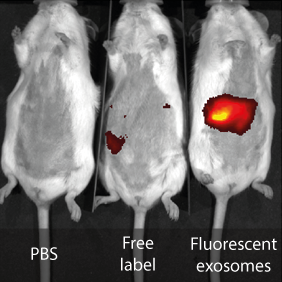
An important factor to understanding the roles of exosomes is knowledge of their biodistribution. Currently, the number of publications describing the biodistribution of exosomes is limited. The main reason being the lack of a robust fluorescent label that can be visualised in vivo. Mapping the specific cell type derived exosomes can increase our knowledge on the roles of exosomes in the organism, as well as help to identify natural targeting systems.

Isolation, Characterisation and Fluorescent Labelling

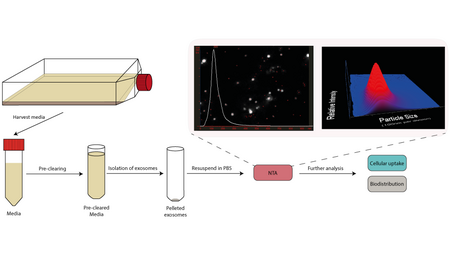
The most common isolation protocol uses a differential centrifugation to fractionate cells, microvesicles, and exosomes, which are pelleted by ultracentrifugation. After vesicles are secreted from cells into the extracellular environment, it difficult to separate the different subpopulations of vesicles to obtain a pure sample. We have developed methods to optimise isolation and thorough characterisation procedures to obtain pure and well-characterised exosomes. Furthermore, we have developed a simple method for labelling of exosomes with a robust fluorescent label that can be visualised in vivo, allowing investigation of the biodistribution of different cell derived exosomes.
Collaborators:

Department of Clinical Medicine, Aarhus University Hospital, Denmark

Dan Peer, Department of Cell Research & Immunology, Tel Aviv University, Israel

Moein Moghimi, school of Medicine, Pharmacy and Health, Durham University, UK

Recent Publications

Sort by: Date | Author | Title

Jakobsen, LS & Larsen, AH 2019, 'Hvordan bruger mænd museer?', Danske Museer, vol. 2019, no. 1, pp. 10-14.
Larsen, SN 2019, Hvordan det begrænset synlige blev til det virkelige. in DD Christoffersen & K Stender Petersen (eds), Er der evidens for evidens?. Samfundslitteratur, Frederiksberg, pp. 167-182.
Robbe, JR 2019, Hvordan en gammel kontrakt kan kaste nyt lys over hollændernes skriftsprog på Amager i 1600-tallet. in KR Christensen, H Jørgensen & JL Wood (eds), The Sign of the V: Papers in Honour of Sten Vikner. AU Library Scholarly Publishing Services, Aarhus, pp. 503-521.
Frederiksen, KS, Pedersen, MU & Jones, S 2019, Hvordan hjælpes unge med psykiske problemer bedst i rusmiddelbehandlingssystemet? in B Bjerge & E Houborg (eds), Rusmiddelbrugere i krydsfeltet mellem sektorer og fagligheder. Aarhus Universitetsforlag, Aarhus, Samfund og Rusmidler, no. 6, pp. 159-181.
Larsen, L 2019, 'HVORDAN KAN FAGPROFESSIONELLE UNDERSTØTTE GAMLE MENNESKER I AT BEVARE LIVSLYST, OG HVORDAN MÅLER VI PÅ DET?', KAN MAN FOREBYGGE ALDERDOMMEN?
, Middelfart, Denmark, 31/10/2019 - 01/11/2019 pp. 11.
Jensen, SS 2019, 'Hvordan kan vi nedsætte luftforureningen', Sundhedsstyrelsens Rådgivende Videnskabelige Udvalg for Miljø og Sundhed, Copenhagen, Denmark, 12/06/2019.
Blom-Hansen, J & Serritzlew, S 2019, Hvordan lægges et offentligt budget? in P Munk Christiansen (ed.), Budgetlægning og offentlige udgifter. 3 edn, Hans Reitzels Forlag, Kbh., Statskundskab, pp. 95-128.
Nissen, P 2019, 'Hvordan måler vi, om eleverne lærer noget i skolen og trives?', Kognition & Pædagogik, vol. 29, no. 111/112, pp. 122 - 129.
Kabel, K, Christensen, MV & Brok, LS (eds) 2019, Hvordan praktiseres grammatikundervisning i dansk, engelsk og tysk? statusrapport Gramma3. VIA University College, København.
Ottosen, C-O 2019, 'Hvordan ser fremtidens proteinafgrøder ud?', Food Festival 2019, Aarhus, Denmark, 06/09/2019 - 08/09/2019.
Svinth, L 2019, 'Hvordan skaber dagtilbud inkluderende fællesskaber for børn i udsatte positioner?', Pædagogisk Psykologisk Tidsskrift, vol. 56, no. 4, pp. 42-66.
Skiveren, T 2019, 'Hvor er den sidste konfrontationsmodernist?', Jyllands-Posten, vol. Sektion 5 (Kultur Weekend), pp. 18.
Bjergkilde, D 2019, Hvorfor er det så svært, når det skulle være så godt? Ledelse og udvikling af professionelle læringsfællesskaber. in F Boye Anderssen (ed.), Team, læringsfællesskaber og ledelse i skolen. Klim, Aarhus.
Blom-Hansen, J 2019, 'Hvorfor er EU-politik så kedeligt?', Administrativ Debat, vol. 2019, no. 2, pp. 9-12.
Larsen, J 2019, 'Hvorfor er hydrodynamiske modeller så lækre og hvordan ser der ud i motorrummet?', 20. Danske Havforskermøde, Odense, Denmark, 23/01/2019 - 25/01/2019.
Lieberoth, A 2019, 'Hvorfor lokker spilskærmene så meget? Motivation, psykologi og syv spillermotiver', Kvan - et tidsskrift for læreruddannelsen og folkeskolen, vol. 114.
Skiveren, T 2019, 'Hvorfor skriver Knausgård?', Jyllands-Posten, vol. Sektion 1 (Kultur), pp. 17.
Sørensen, LB & Nielsen, K 2019, Hvorfor undervise i engineering i grundskolen? in Engineering. VIA University College, Aarhus, Liv i skolen : tidsskriftet om lærernes hverdag og det gode arbejde i skolen, no. 2, vol. 2019, pp. 20-29.
Thomsen, KR 2019, 'Hvornår er vi afhængige af noget, og hvornår er et stort brug problematisk?', Generation Skærm, København, Denmark, 12/03/2019 - 12/03/2019.
Larsen, SN 2019, 'Hvor sidder viljen?', Information, pp. 22.
Hermann, A 2019, Hvor to er ét, er helvede forbi: Senromantiske forestillinger om kvinden som mandens forløser. in D Bugge & A Hermann (eds), Moder, søster, elskte: Frelsende kvindeskikkelser i dansk litteratur. Eksistensen Akademisk, København, pp. 11-34.
Ivanov, AS, Mihovska, AD, Poulkov, V & Prasad, R 2019, 'Hybrid Accuracy-Time Trade-off Solution for Spectrum Sensing in Cognitive Radio Networks', International Journal of Mobile Network Design and Innovation, vol. 9, no. 1, pp. 1-13. https://doi.org/10.1504/IJMNDI.2019.098223
Neumayr, T, Saatci, B, Augstein, M, Jetter, H-C, Klokmose, CN, Anderst-Kotsis, G & Rintel, S 2019, Hybrid Collaboration – Moving Beyond Purely Co-Located or Remote Collaboration. in ECSCW 2019: Proceedings of the 17th European Conference on Computer-Supported Cooperative Work: The International Venue on Practice-centred Computing and the Design of Cooperation Technologies - Workshop Proposals. Reports of the European Society for Socially Embedded Technologies: , no. 2, vol. 3. https://doi.org/10.18420/ecscw2019_ws3