Aarhus University Seal

Exosomes

Exosomes are small membrane vesicles of endocytic origin secreted by most cell types in vitro. Cells continuously secrete a large number of microvesicles, exosomes and small molecules into the extracellular space. Exosomes have been shown to contain mRNA and miRNA and they are able to mediate communication between cells, by transport of RNA and proteins which can be functionalized in the recipient cell. The ability to transport bioactive cargoes, gives exosomes innate therapeutic potential as a natural drug carrier. Efficient techniques for loading drugs into exosomes to utilize the natural carrier capabilities of these vesicles remains to be elucidated.
Applications of Exosomes

The presence exosomes in blood, saliva, and urine paves the way for the possible application of exosomes as a diagnostic marker for diseases. Many diseases are difficult to detect by the methods and equipment available today and there is a growing demand for development of new non‐invasive methods to detect diseases in early stages. The use of exosomes as markers of disease is being investigated to cement their potential as a non-invasive diagnostic tool for early detection of many diseases, in particular cancers. This, however, relies on thorough characterisation of exosomes in both healthy and diseased states

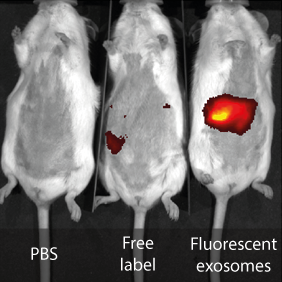
An important factor to understanding the roles of exosomes is knowledge of their biodistribution. Currently, the number of publications describing the biodistribution of exosomes is limited. The main reason being the lack of a robust fluorescent label that can be visualised in vivo. Mapping the specific cell type derived exosomes can increase our knowledge on the roles of exosomes in the organism, as well as help to identify natural targeting systems.

Isolation, Characterisation and Fluorescent Labelling

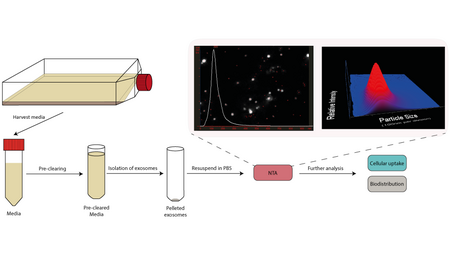
The most common isolation protocol uses a differential centrifugation to fractionate cells, microvesicles, and exosomes, which are pelleted by ultracentrifugation. After vesicles are secreted from cells into the extracellular environment, it difficult to separate the different subpopulations of vesicles to obtain a pure sample. We have developed methods to optimise isolation and thorough characterisation procedures to obtain pure and well-characterised exosomes. Furthermore, we have developed a simple method for labelling of exosomes with a robust fluorescent label that can be visualised in vivo, allowing investigation of the biodistribution of different cell derived exosomes.
Collaborators:

Department of Clinical Medicine, Aarhus University Hospital, Denmark

Dan Peer, Department of Cell Research & Immunology, Tel Aviv University, Israel

Moein Moghimi, school of Medicine, Pharmacy and Health, Durham University, UK

Recent Publications

Sort by: Date | Author | Title

Hymøller, L & Jensen, SK 2015, 'We know next to nothing about vitamin D in horses!', Journal of Equine Veterinary Science, vol. 35, no. 10, pp. 785-792. https://doi.org/10.1016/j.jevs.2015.06.010
Christensen, KR 2015, 'Welcoming and taking good care of the new PhD student - experiences from the PhD programme', University of Ghana Doctoral Students Research Conference, Accra, Ghana, 05/11/2015 - 06/11/2015.
Møller, SH, Hansen, SW, Malmkvist, J, Vinke, CM, Lidfors, L, Gaborit, M & Botreau, R 2015, Welfare assessment protocol for mink. Fur Europe.
Rousing, T, Sørensen, JT, Kudahl, AB & Pedersen, LJ 2015, Welfare of nursing sows and their piglets - results from a Danish Cross-sectional study. in Improving Pig Welfare - what are the ways forward?. pp. 141-141, International conference on pig welfare: Improving pig welfare – what are the ways forward?, Copenhagen, Denmark, 29/04/2015.
Magaard, T 2015, 'Wellfare delicacies’ as a New Nordic agricultural sustainability concept. A physiosophical perspective', Sustainability in a Scandinavian Context Conference 2015 , Copenhagen, Denmark, 08/06/2015 - 09/06/2015.
Wedell-Wedellsborg, A 2015, 'wenben zhong de xing ying xiang diao: zhongguo wenxue de gudu geti', China Scholarship (Zhongguo Xueshu), vol. 11, no. 2, pp. 231-258.
Aschemann-Witzel, J & Aagaard, EMN 2015, '„Wenn ich mal mehr Geld habe, dann …“ Point of Sale Abwägungen für und wider ökologische Lebensmittel bei jungen Dänischen Konsumentinnen und Konsumenten.', Paper presented at Wissenschaftstagung Ökologischer Landbau, Eberswalde, Germany, 17/03/2015 - 20/03/2015.
Ahn, B, Stevnsner, T & Bohr, VA 2015, Werner syndrome: Association of premature aging and cancer predisposition. in EP Gelmann, CL Sawyers & FJ Rauscher, III (eds), Molecular Oncology: Causes of Cancer and Targets for Treatment. Cambridge University Press, pp. 423-433. https://doi.org/10.1017/CBO9781139046947.036
Gould, A, Huber, D, Penny, M & Stello, D 2015, 'WFIRST ULTRA-PRECISE ASTROMETRY II: ASTEROSEISMOLOGY', Journal of the korean astronomical society, vol. 48, no. 2, pp. 93-104. https://doi.org/10.5303/JKAS.2015.48.2.93
Haddaway, NR, Hedlund, K, Jackson, LE, Kätterer, T, Lugato, E, Thomsen, IK, Jørgensen, HB & Söderström, B 2015, 'What are the effects of agricultural management on soil organic carbon in boreo-temperate systems?', Environmental Evidence, vol. 4, no. 23. https://doi.org/10.1186/s13750-015-0049-0
Moos, L 2015, What are the fundamental tensions in educational leadership between tests and curiosity? in D Griffiths & JP Portelli (eds), Key questions for educational leaders. Word and Deed Publishing, Burlington, Ontario, pp. 225-228.
Boonstra, WJ, Ottosen, KM, Richter, A, Rogers, LA, Pedersen, MW, Kokkalis, A, Bardarson, H, Bonanomi, S, Butler, W & de Araujo Ferreira, AS 2015, 'What are the major global threats and impacts in marine environments? Investigating the contours of a shared perception among marine scientists from the bottom-up.', Marine Policy, vol. 60, pp. 197-201.
D'Ausilio, A, Novembre, G, Fadiga, L & Keller, PE 2015, 'What can music tell us about social interaction?', Trends in Cognitive Sciences, vol. 19, no. 3, pp. 111-114. https://doi.org/10.1016/j.tics.2015.01.005
Ehrich, D, Ims, RA, Yoccoz, N, Lecomte, N, Killengreen, S, Fuglei, E, Rodnikova, A, Ebbinge, B, Menyushina, I, Nolet, B, Pokrovsky, I, Popov, I, Schmidt, NM, Sokolov, A, Sokolova, N & Sokolov, V 2015, 'What can stable isotope analysis of top predator tissues contribute to monitoring of tundra ecosystems?', Ecosystems, vol. 18, no. 3, pp. 404-416. https://doi.org/10.1007/s10021-014-9834-9
Lønneker, AMK 2015, 'What Can This Sorrow Be?': Elegiac Affectivity in Virginia Woolf's Jacob's Room. in D Sharma & F Tygstrup (eds), Structures of Feeling: Affectivity and the Study of Culture. De Gruyter, Berlin/Munich/Boston, Concepts for the Study of Culture, vol. 5, pp. 169-177.
Jensen, UJ & Mattingly, C 2015, What Can We Hope For? An Exploration in Cosmopolitan Philosophical Anthropology. in S Liisberg, EO Pedersen & AL Dalsgård (eds), Anthropology and philosophy: dialogues on trust and hope. Berghahn Books, Oxford, pp. 24-56.
Tedesco, M, Doherty, S, Warren, S, Tranter, M, Stroeve, J, Fettweis, X & P, A 2015, 'What darkens the Greenland Ice Sheet?', EOS, vol. 96. https://doi.org/10.1029/2015EO035773
Rittenhofer, I 2015, 'What do Coke and Broen have in common? Contribution to conference panel', Television in the Age of Transnationalisation and Transmedialisation', London, United Kingdom, 22/06/2015 - 23/06/2015. <http://estore.roehampton.ac.uk/browse/extra_info.asp?compid=1&modid=2&catid=156&prodid=196>
Engberg, J 2015, 'What does it mean to see Legal translation as knowledge communication? Conceptualisation and quality standards', Terminology science and research - Journal of the International Institute of Terminology Research, vol. 25, pp. 1-10.
Cox, G 2015, What Does Live Coding Know? in A McLean, T Magnusson, K Ng, S Knotts & J Armitage (eds), Proceedings of the First International Conference on Live Coding. University of Leeds, Leeds, International Conference on Live Coding, Leeds, United Kingdom, 13/07/2015.
Goduscheit, RC, Gerstlberger, W & Knudsen, MP 2015, What drives Innovation with an Environmental Impact and how does it Impact Product Innovation Performance? in 22nd Innovation & Product Development Management Conference: Improving competitiveness with innovation and product development. European Institute for Advanced Studies in Management, Uden navn, 22nd Innovation and Product Development Management Conference, Copenhagen, Denmark, 14/06/2015. <http://www.eiasm.org/frontoffice/event_announcement.asp?event_id=1079>
Frederiksen, MD & Harboe Knudsen, I 2015, What is a Grey Zone and Why is Eastern Europe One? in Ethnographies of Grey Zones in Eastern Europe: Relations, Borders and Invisibilities. Anthem Press, pp. 1-25.
Elkjær, B 2015, 'What is an organization that it may learn?', Paper presented at Conference on Learning, Oslo, Denmark, 01/06/2015 - 03/06/2015.
Hebsgaard, SM, Andersen, RS, Risør, MB & Vedsted, P 2015, 'What is a symptom? Sensation to symptom-transformations in everyday life', Aarhus University Graduate School of Health PhD Day 2015: academic doping, Denmark, 23/01/2015.
Holm-Nielsen, LB 2015, What is at the horizon for European Universities? in T Luque Martínez (ed.), Horizon 2031: The University of Granada in Light of its V Centenary. “Reflections on the Future of the University". Granada, pp. 25-31.